


Cash flow is the lifeblood of any organisation. It's a key indicator of financial health, showing how well a company can generate and manage cash to meet obligations, invest and grow.
Yet, cash flow management for growing businesses can become a headache if it's not dealt with effectively. To do this, business owners need to be aware of the different cashflow methods, notably indirect and direct, and decide which to use.
In this article:
- Direct vs indirect cash flow: key differences
- Which method should you use?
- The three types of cash flow
- Direct vs indirect cash flow: in detail
- Direct vs indirect cash flow: pros and cons
- Which method is right for your business?
- Cash flow statement
- A more strategic approach to cash flow management
- FAQs on direct vs indirect cash flow
Cash flow is the net amount of cash and cash equivalents moving in and out of a business over a specific period. It's a key benchmark of financial performance, providing insight into a company's ability to generate cash from its core operations, investments and financing activities.
Direct vs Indirect Cash Flow: Key Differences
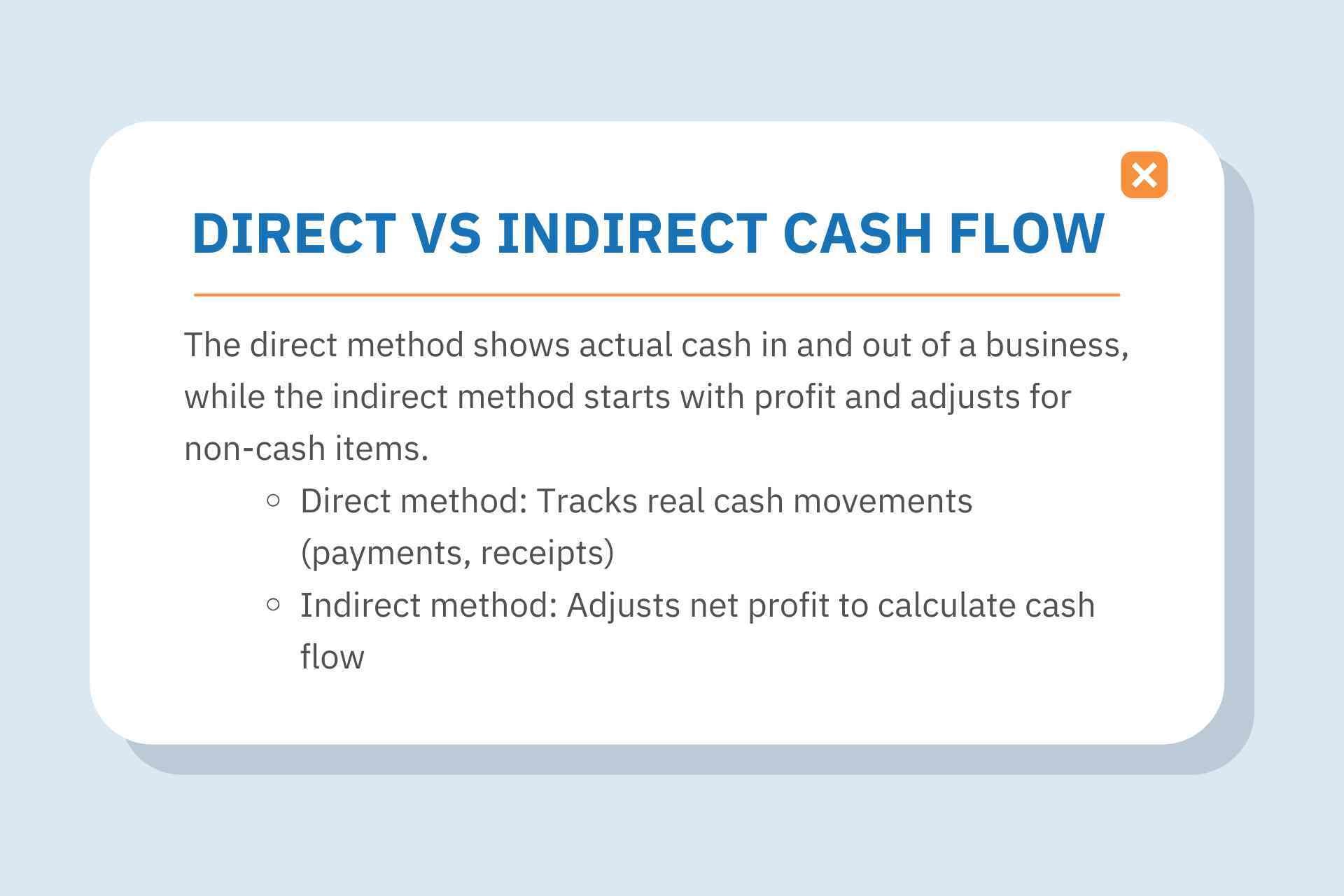 The direct method shows actual cash in and out of a business, while the indirect method starts with profit and adjusts for non-cash items.
- Direct method: Tracks real cash movements (payments, receipts)
- Indirect method: Adjusts net profit to calculate cash flow
Which method should you use?
Improving cash flow in a growing business is imperative and most use the indirect method because it’s easier to prepare and aligns with standard accounting practices.
However, the direct method can provide clearer visibility if you need detailed insight into cash movements.
The Three Types of Cash Flow
Before comparing these methods, it’s useful to understand the three types of cash flow reported in a cash flow statement:
| Activity | Source | Inflows | Outflows |
| Operating | Cash generated from day-to-day business operations. | Sales revenue, interest received, dividends received. | Payments to suppliers, employee salaries, rent, utilities, taxes. |
| Investing | Cash used for investments in assets. | Proceeds from the sale of assets and collection of loans. | Purchase of property, plant and equipment, or investments in other companies. |
| Financing | Cash from raising capital or repaying debt. | Proceeds from issuing stock or bonds, borrowing money. | Repayment of debt, payment of dividends. |
Direct vs Indirect Cash Flow: In Detail

The direct and indirect methods are two approaches to preparing the cash flow statement, an important financial statement that summarises a company's cash flow over a specific period. Both methods focus on reporting cash flow from operating activities, but they differ in how they arrive at the final figure.
Direct Cash Flow Method
The direct method is best suited to businesses that want detailed, real-time visibility of cash movements.
- Focus: Directly reports actual cash inflows and outflows from operating activities.
- Presentation: Lists major categories of cash receipts and payments, including:
- Cash received from customers
- Cash paid to suppliers and employees
- Interest paid
- Taxes paid
- Transparency: Offers a clear, granular view of where cash is coming from and where it's going.
Indirect Cash Flow Method
The indirect method is more commonly used by growing businesses because it is simpler to prepare and aligns with existing financial reporting.
- Starting Point: Begins with net income from the income statement (profit and loss account).
- Adjustments: Reconciles net income to cash flow from operations by:
- Adding back non-cash expenses (depreciation, amortisation)
- Adjusting for changes in working capital (debtors, inventory, creditors)
- Ease of Preparation: Often preferred because it's less time-consuming and aligns with the accrual accounting method used for income statements.
Direct vs Indirect Cash Flow: Pros and Cons
| Method | Advantages | Disadvantages |
| Direct | Greater transparency, easier for stakeholders to understand, provides detailed insights into operating cash flows. | More time-consuming to prepare, requires detailed transaction records, may not be feasible for all businesses. |
| Indirect | Easier and faster to prepare, aligns with accrual accounting, highlights the impact of non-cash items on cash flow. | Less transparent, may be harder for non-accountants to understand, doesn't show specific cash transactions. |
Which Method is Right for Your Business?
Most business owners don't make this choice because of an accounting preference; it's more about saving time and making better financial decisions.
The choice between the direct and indirect methods depends on various factors:
- Business Size and Complexity: Smaller businesses may find the direct method easier, while larger companies with complex transactions might prefer the indirect method.
- Accounting Practices: If your business already uses accrual accounting, the indirect method might be simpler to implement.
- Stakeholder Needs: Consider who will be using the cash flow statement. If transparency is crucial for investors or lenders, the direct method might be preferred.
- Use the direct method if:
- You want detailed visibility of cash movements
- You have systems to track transactions accurately
- You need transparency for stakeholders
- Use the indirect method if:
- You want a quicker, simpler approach
- You already use accrual accounting
- You need a high-level view to support decision-making
In practice, most growing businesses use the indirect method for reporting, while relying on forecasting and management tools for day-to-day cash visibility.
Cash Flow Statement
Whether you use the direct or indirect method, the cash flow statement is a powerful tool for assessing your company's financial health and making strategic decisions. By analysing cash flow patterns and engaging in cash flow forecasting, you can:
- Measure Liquidity: Determine your ability to meet short-term financial obligations, a key aspect of managing your cash flow.
- Assess Profitability: Evaluate how efficiently your business generates cash from operations.
- Identify Trends: Spot changes in your cash flow patterns over time to "Improve Cash Flow" and navigate economic challenges.
- Make Informed Decisions: Plan for the future, allocate resources effectively, and secure financing if needed, even in times of "Economic Chaos."
A More Strategic Approach to Cash Flow Management
Understanding which cash flow method to use is only part of the picture. The real value comes from using financial information to make better decisions.
If you’re running a growing business and want clearer insight into your financial position, TAB can help you interpret your numbers and take a more strategic approach to cash flow management.
FAQs on direct vs indirect cash flow
What is the difference between direct and indirect cash flow?
The direct method shows actual cash transactions, while the indirect method adjusts net income to calculate cash flow.
Which cash flow method is better?
The indirect method is more commonly used due to its simplicity, but the direct method offers greater transparency.
Why do most businesses use the indirect method?
Because it aligns with accrual accounting and is quicker to prepare.
Related articles

Cash Flow Management: How to Take Control in a Growing Business
Here's a solid framework of cash flow management, especially for growing businesses, including the most common cash flow mistakes growing businesses make.

Leadership Training for Managers: Why SMEs Can’t Ignore It
Discover why leadership training for managers is vital for SME growth and how HI-MAP turns learning into action.

Company Culture Examples: What SMEs Can Learn from Real Businesses
Discover real company culture examples and practical tips to build a thriving workplace in your small or medium-sized business.

10 Proven Strategies for Organic Business Growth
Discover effective strategies for achieving organic business growth. Boost your business' success with actionable tips and insights for sustainable growth.

Business Analysis Tools: 5 Proven Tools & Techniques
Learn how the right business analysis tools can transform decision-making, improve results and help business owners achieve lasting growth.