

.jpg)
Managing Decision Fatigue as a Business Owner: How to Think Clearly and Lead Better
Running a business means making decisions all day, every day. From strategic direction to operational details, a business owner is constantly required to evaluate options, weigh-up risks and act quickly.
Over time, this constant pressure can lead to decision fatigue – a cognitive drain that reduces the quality of decisions made at work. For many business leaders, this isn’t just a productivity issue; it can directly impact performance, profitability and long-term growth.
Understanding how decision fatigue in business develops, and how to manage it, is essential for your leadership and the growth of your business.
What is Decision Fatigue? Definition and Symptoms
Decision fatigue refers to the mental exhaustion that results from making too many decisions over a prolonged period, even in a single day.
For a business owner, symptoms often show up in subtle but impactful ways:
- Avoiding decisions or delaying action
- Opting for the easiest rather than the best solution
- Reduced focus and clarity at work
- Increased impulsivity or inconsistent judgement
- Feeling overwhelmed by routine business choices
Left unchecked, decision fatigue can contribute to wider challenges such as burnout, which is explored further in our guide to business owner burnout.
Why Decision Fatigue Happens (And Why It Matters)
At its core, decision fatigue is about mental energy.
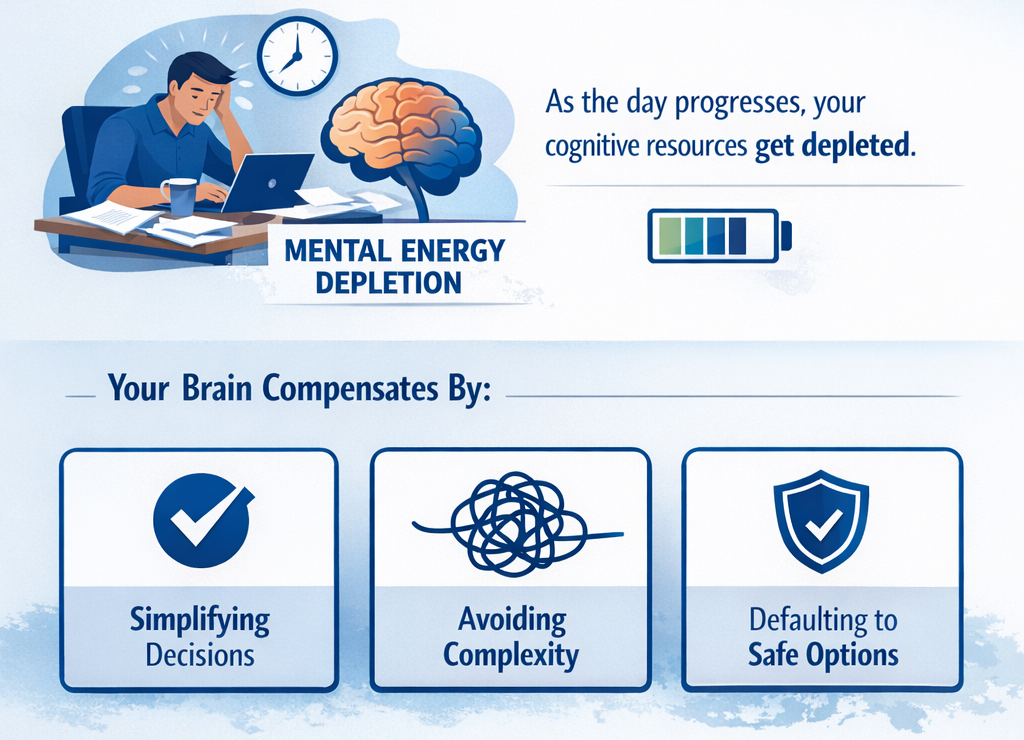
Your brain draws on finite cognitive resources to evaluate options, assess risk and make calls. As the day progresses, those resources get depleted.
When that happens, your brain starts to compensate by:
- Simplifying decisions
- Avoiding complexity
- Defaulting to familiar or ‘safe’ options
That’s why your best thinking often happens early in the day and why late decisions can feel harder than they should.
From a business perspective, this can lead to:
- Missed opportunities
- Poor strategic calls
- Inconsistent leadership
- Reduced confidence in decision-making
Here’s the key point: this isn’t about capability, it’s about capacity.
Where Business Owners Feel It Most
Decision fatigue doesn’t happen in isolation, it builds through the realities of running a business.
1. High-Stakes Pressure
Every decision carries weight, whether that’s financial, operational or reputational. That pressure adds up quickly.
2. Volume of Decisions
On any given day, you’re likely switching between:
- Strategy
- Operations
- People management
- Financial oversight
- Personal admin tasks
That constant switching accelerates mental fatigue.
3. Delegation Gaps
Many business owners and leaders hold onto decisions they don’t need to make, often due to habit, trust concerns or a desire for control.
The result? More decisions, less clarity.
4. Leadership Isolation
Without a sounding board, decisions happen in your own head, leading to second-guessing and mental overload.
A Simple Framework to Reduce Decision Fatigue
One of the most effective ways to regain clarity is to reduce the number of decisions you personally carry.
Try this simple three-level filter:
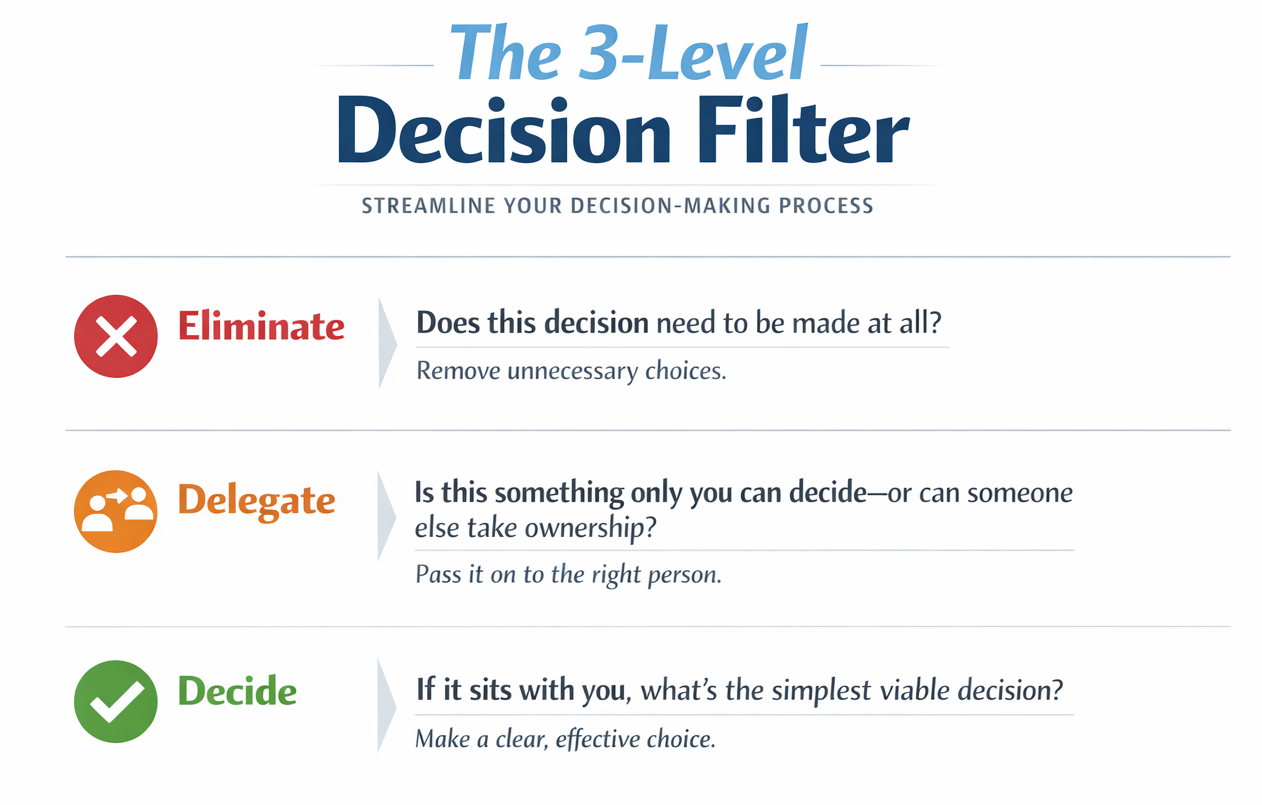
The 3-Level Decision Filter
1. Eliminate
Does this decision need to be made at all?
2. Delegate
Is this something only you can decide, or can someone else take ownership?
3. Decide
If it sits with you, what’s the simplest viable decision?
This approach acts as a practical time management tool and helps prioritise high-impact thinking.
Using AI to Reduce Decision Fatigue
AI can reduce decision fatigue in business by automating routine choices, analysing data and presenting clear recommendations, but it can also increase cognitive load if overused.
For a business owner, AI is most effective when it removes low-value decisions and supports faster, clearer thinking at work.
How AI Helps Reduce Decision Fatigue
Used well, AI tools can:
- Automate repetitive business decisions
- Analyse complex data quickly
- Highlight key insights and trends
- Provide structured recommendations
For example, AI-driven dashboards can quickly surface changes in cash flow, customer behaviour or team performance, freeing you up to focus on what matters most.
When AI Increases Decision Fatigue
According to Harvard Business Review (When Using AI Leads to Brain Fry), AI can sometimes increase mental strain rather than reduce it.
This happens when AI:
- Produces too many options to evaluate
- Requires constant verification of outputs
- Adds complexity instead of clarity
- Creates uncertainty around final decisions
- Filter information, not add to it
- Simplify decisions, not complicate them
- Support human judgement, not replace it
This effect, often referred to as ‘AI brain fry’, can leave business owners just as fatigued as before.
Best Practice on AI for Business Owners
To reduce decision fatigue effectively, AI should be used to:
Combining AI with structured decision-making tools and peer input ensures it enhances, rather than overwhelms, decision-making in business. Read more about the truth about AI in business.
Practical Ways to Reduce Decision Fatigue
Alongside frameworks and tools, small changes can make a big difference:
- Make important decisions earlier in the day
- Standardise routine choices where possible
- Build systems that reduce repeat thinking
- Delegate with clear accountability (decision fatigue is only one of the benefits of delegation)
- Create space for strategic thinking
- Seek external perspective before big decisions
Because better decisions rarely come from doing more, they come from thinking more clearly. When it comes to delegation, check out our guide to leadership training for managers so you can spend more time on decisions that matter most.
Case Study: Kerrell Blyth, Business Owner in Yorkshire
 Kerrell Blyth, Managing Director of NCS Ltd, recognised the need for external support to address her feelings of loneliness in the decision-making process and prevent work-related discussions from burdening her personal relationships.
A customer introduced her to the concept of peer boards.
Kerrell’s TAB board has played a vital role in validating her business decisions in key areas such as finances, HR, and client relationships.
Through discussions with her peers, Kerrell gained valuable insights, rationalised her thoughts and made better-informed decisions. She believes running her business effectively would be challenging without TAB's support and guidance.
Read more about Kerrell’s story
FAQs About Decision Fatigue in Business
What is decision fatigue in business?
Decision fatigue in business refers to the decline in decision quality after a long session of decision-making, commonly experienced by business owners and leaders.
How does decision fatigue affect performance at work?
It can lead to slower thinking, poorer judgement, avoidance of important decisions and increased stress levels.
Can decision fatigue be prevented?
It can be managed through structured decision-making processes, delegation, prioritisation and support systems such as business coaching.
Is decision fatigue linked to burnout?
Yes. Ongoing decision fatigue can contribute to emotional and mental exhaustion, increasing the risk of burnout.
What are simple ways to reduce decision fatigue?
- Limit low-value decisions
- Use systems and frameworks
- Delegate effectively
- Seek external perspectives
- Use tools to streamline choices
How TAB Helps Business Owners Think Better
The Alternative Board (TAB) provides structured support that directly addresses the root causes of decision fatigue in business.
Through a combination of peer advisory boards, coaching and proven frameworks, business owners can reduce the cognitive load of decision-making.
For many business owners, the turning point comes when they stop making every decision alone.
At TAB, the focus isn’t just on making better decisions, it’s about making fewer, more confident ones, and understanding the benefits of delegation through programmes like StratPro for your senior leadership teams.
Through TAB's peer advisory boards, coaching, strategic planning and business tools, business owners gain:
- Perspective → Real-world input from other experienced leaders
- Clarity → Structured thinking around complex decisions
- Accountability → Focus on what truly matters
- Confidence → Backed by insight, not guesswork
The result? Decision-making becomes a strength again, not a drain.
For example, Matt Hamlin, co-founder, CEO and director of Metron Group Ltd said this:
“There’s a sense of solidarity with the peer support you get at TAB. It’s a non-threatening environment where you get more and more comfortable speaking up and challenging each other. It has served as a great sounding board for me, bringing a new level of clarity.”
Read more about how peer support builds stronger business leaders.
Final Thoughts
Decision fatigue is a natural part of running a business, but it doesn’t have to define how you lead.
With the right structure, tools and support, you can reduce the noise, protect your mental energy and focus on the decisions that truly move your business forward.
Because leadership isn’t about making more decisions.
It’s about making better ones with clarity, confidence and control.
Related articles
How Better Decision-Making Tools Help Leaders Act With Confidence
How simple decision-making tools like scorecards, dashboards, and decision matrices help business leaders cut through noise and make confident decisions.

Business Analysis Tools: 5 Proven Tools & Techniques
Learn how the right business analysis tools can transform decision-making, improve results and help business owners achieve lasting growth.

The Loneliness Premium: What Isolated Leaders Cost Their Businesses
Explore the hidden cost of CEO leaders loneliness and how peer support and smart leadership strategies improve SME performance and decision-making

The real test of business strategy: what happens when you’re not there?
Why does your team still rely on you for every decision? Learn how to build an aligned team that turns strategy into action and reduces owner dependency.

Company Culture Examples: What SMEs Can Learn from Real Businesses
Discover real company culture examples and practical tips to build a thriving workplace in your small or medium-sized business.

10 Proven Strategies for Organic Business Growth
Discover effective strategies for achieving organic business growth. Boost your business' success with actionable tips and insights for sustainable growth.
Business Analysis Tools: 5 Proven Tools & Techniques
Learn how the right business analysis tools can transform decision-making, improve results and help business owners achieve lasting growth.