


How Do Successful CEOs Manage Their Time?
Many business owners assume that successful CEOs simply work longer hours.
The research suggests otherwise.
Studies into executive time management show that high-performing CEOs spend their time differently from most business owners. Rather than focusing exclusively on operational tasks, they allocate significant portions of their schedule to:
- Strategic planning
- Leadership development
- Decision-making
- Stakeholder management
- Organisational performance
Research published by Harvard Business Review found that CEOs dedicate substantial time to people, strategy and organisational leadership rather than purely operational activity.
The lesson is clear.
The challenge is not fitting more tasks into the day. The challenge is ensuring that your time is invested in the activities that create the greatest long-term value.
This is where time management theories become particularly useful. They provide practical frameworks that help business owners prioritise more effectively, delegate with confidence and focus on what matters most.
In this guide, we’ll explore the most influential time management theories and show how CEOs and business leaders can apply them to improve decision-making, delegation and business performance.
Key Takeaways for Business Owners to Manage Their Time
- Discover proven time management theories (e.g. Eisenhower Matrix, Pareto Principle, Parkinson’s Law).
- Learn practical strategies to prioritise tasks, reduce overwhelm and improve focus as a business leader.
- Find out how to adapt techniques to the reality of running a business, whether managing client deadlines, finances or your team.
- Gain habits that boost productivity and decision-making so you can refocus on business growth.
- Learn how TAB helps business owners reclaim time through accountability, strategic planning and peer support.
%2010%20Practical%20Ways%20to%20Take%20Back%20Your%20Time%20-%20Business%20Guide%202025%20Clocks%20(1).jpg?width=750&height=500&name=TAB%20(UK)%2010%20Practical%20Ways%20to%20Take%20Back%20Your%20Time%20-%20Business%20Guide%202025%20Clocks%20(1).jpg)
In this article:
- What is time management?
- Theoretical Foundations of Time Management
- Pareto Principle
- Eisenhower Matrix
- Parkinson's Law
- Psychological Aspects of Time Management
- Four Executive Time Management Strategies Every CEO Should Use
- Why Most CEOs Don't Actually Have a Time Management Problem
- How TAB Helps CEOs Improve Their Time Management
What is Time Management?
Simply put, time management involves organising, planning, and strategically controlling the time you dedicate to specific tasks. When done correctly, it allows you to accomplish more in less time, even when faced with tight deadlines and a never-ending to-do list.
Research by Instantprint found that poor time management is the biggest obstacle to growth for UK SMEs. According to the study, business owners lose a staggering 10 hours a week to distractions. Surprisingly, a quarter believe that having more staff is the answer. Yet, the same research suggests that better time management could free up their time for strategic tasks by allowing for more effective delegation.
🔹 Related: 4-Step guide to strategic planning
Proper time management can unlock hidden potential in your business. By streamlining processes and delegating tasks, you'll free up valuable time to focus on strategic growth and leverage your core strengths.
Effective time management allows business leaders to:
- Improve productivity and performance.
- Focus on strategic business growth.
- Make better decisions.
- Reduce stress and overwhelm.
The most successful business owners understand that time is not simply something to manage. It is their most valuable business asset.
🔹 Related: 4 quick tips to achieve your work-life balance
Theoretical Foundations of Time Management
In the world of business ownership, it's important to master the art of time management. Good time management practices are based on three key theories:
Understanding these theories is essential for business owners to optimise time management strategies, improve decision-making and enhance task prioritisation capabilities.
Pareto Principle (80/20 Rule)

The Pareto Principle, more commonly known as the 80/20 rule, states that approximately 80% of results come from 20% of effort.
Applied to time management, this principle suggests that a small proportion of our actions significantly contributes to our overall success and productivity.
For business owners, this means identifying and focusing on the critical tasks that drive most of your business value.
By recognising these key activities, you can allocate your time more effectively and ensure your efforts are concentrated on high-impact tasks that propel your business forward.
What This Means for CEOs
Many business owners spend too much time on low-value activities.
The Pareto Principle challenges leaders to ask:
- Which clients generate most of our revenue?
- Which activities drive the greatest growth?
- Which decisions create the biggest impact?
Executive time management is often about identifying the critical 20% of activities that generate 80% of business value and protecting time for them.
Eisenhower Matrix
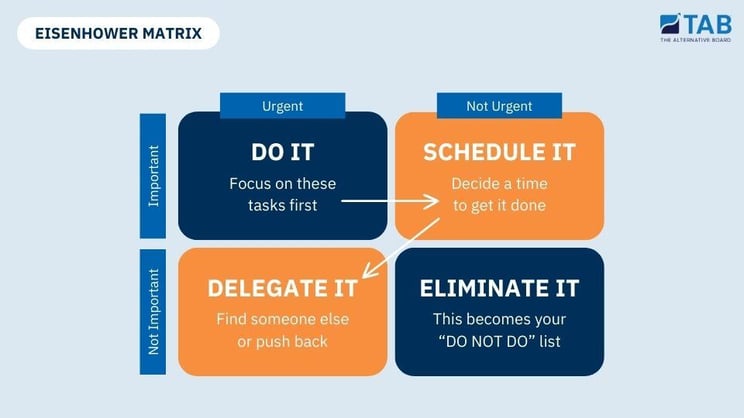
The Eisenhower Matrix, named after President Dwight D. Eisenhower, is a time management tool to help you prioritise tasks based on urgency and importance.
The matrix is divided into four quadrants:
- Urgent and Important (Do First): Tasks requiring immediate attention and significant consequences.
- Important but Not Urgent (Schedule): Tasks that contribute to long-term goals and development but do not require immediate action.
- Urgent but Not Important (Delegate): Tasks that need to be completed soon but do not significantly contribute to long-term objectives.
- Neither Urgent nor Important (Eliminate): Activities that offer little to no value and should be minimised or eliminated.
Using the Eisenhower Matrix, you can clarify what needs immediate attention versus what can be planned, delegated or eliminated.
This strategic approach to task prioritisation ensures that your time is spent on activities that align with your overarching business goals.
How CEOs Should Apply the Eisenhower Matrix
Many growing businesses become overly dependent on the owner because every decision, approval and problem flows through them.
One of the most valuable executive time management skills is learning which responsibilities genuinely require CEO involvement and which can be delegated.
Strong delegation processes and effective team management allow business owners to spend more time on strategic priorities and less time firefighting.
🔹 Related: Effective team management for business owners
Parkinson's Law
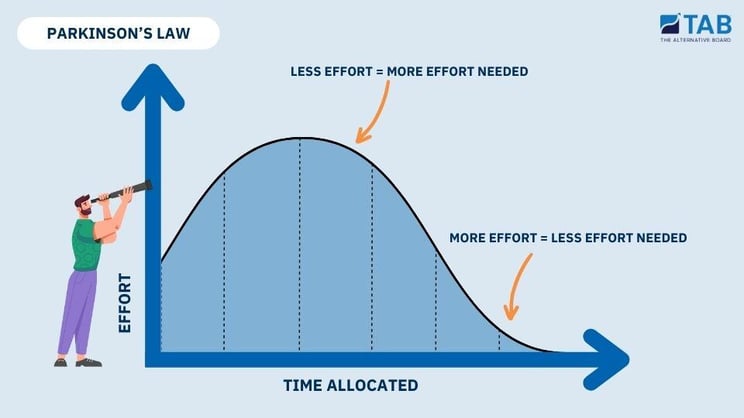
Parkinson's Law states that "work expands to fill the time available for its completion."
This suggests that the more time you allocate to a task, the longer it will take to complete, often due to decreased efficiency and increased complexity.
Applying Parkinson's Law means you should set tighter deadlines to encourage focus and efficiency. This prevents tasks from unnecessarily dragging on and consuming valuable time.
Why Parkinson's Law Matters for Business Owners
Many CEOs become trapped in operational work because there is always another email, meeting or issue demanding attention.
Without deliberate constraints, operational tasks expand to consume time that should be dedicated to strategic planning, leadership development and business growth.
Successful CEOs create protected time for high-value thinking rather than allowing daily demands to dictate their priorities.
Psychological Aspects of Time Management
Beyond these theories, the psychological aspects of time management play a significant role in their practical application.
Procrastination and motivation are two critical psychological factors that influence time management.
Procrastination
Delaying or postponing tasks is a common barrier to effective time management.
For business owners, this often appears with areas such as:
- Difficult conversations
- Strategic planning
- Performance management
- Long-term business decisions
Procrastination can be countered by understanding its underlying causes, such as fear of failure or perfectionism, and employing strategies like breaking tasks into smaller, more manageable steps.
Motivation
Motivation drives the willingness to complete tasks.
Setting clear, achievable goals, rewarding progress, and creating a supportive work environment can enhance motivation.
Why Business Owners Struggle With Time Management
With these psychological factors considered, many business owners don't simply face a time management challenge.
They face:
- Decision fatigue
- Founder dependency
- Leadership bottlenecks
- Reluctance to delegate
- Constant operational interruptions
Understanding and leveraging the psychological aspects of time management can help you and your team overcome barriers to better time management, ensuring that both short-term tasks and long-term goals are accomplished efficiently and effectively.
By integrating the time management principles of the Pareto Principle, Eisenhower Matrix, and Parkinson's Law, along with a deep understanding of the psychological elements at play, you can craft a robust framework for managing your time.
This not only boosts productivity and efficiency but also fosters a work culture that prioritises strategic planning and goal-oriented action.
In addition, by recognising these patterns, CEOs can avoid issues that significantly contribute to stress and exhaustion.
🔹 Related: Business Owner Burnout and How to Avoid It
Four Executive Time Management Strategies Every CEO Should Use
1. Set Clear Goals and Objectives
The foundation of effective time management is the establishment of clear, achievable goals and objectives.
This means setting strategic business goals and defining short-term objectives that support these larger ambitions.
Utilising the SMART criteria (Specific, Measurable, Achievable, Relevant, and Time-bound) can ensure your goals are well-defined and attainable within a realistic timeframe.
This clarity in goal-setting provides direction and focus, enabling you to allocate your time and resources efficiently.
🔹 Related: What are SMART KPIs and How Can I Apply Them?
2. Delegate Responsibilities
Delegation is a powerful tool.
It allows you to focus on high-value activities while empowering your team.
Effective delegation involves:
-
Identifying the right tasks to delegate
-
Choosing competent team members
-
Providing clear instructions and the necessary resources.
-
Trusting your team with these responsibilities and avoiding micromanagement
🔹 Related: The advantages and disadvantages of delegation
Delegation is not about losing control.
It is about ensuring that CEOs focus on activities only they can perform.
Developing strong managers is often essential to successful delegation.
🔹 Related: Leadership Training For Managers
3. Time Management and Productivity Tools
Leveraging technology is pivotal in enhancing time management and productivity in today's digital age.
Business owners should explore and adopt tools and software designed for task management, project collaboration, scheduling, and communication.
From cloud-based project management platforms like Asana and Trello to time-tracking apps like Toggle and communication tools like Slack.
The right technology can:
-
Streamline your operations
-
Facilitate remote work
-
Keep your team aligned and focused
🔹 Related: Nine Time Management Tools For Business Leaders
4. Time Blocking and Batching
Time blocking and batching are techniques that can significantly increase efficiency and productivity.
Time blocking involves dedicating specific blocks of time to particular tasks or categories of work.
Batching, on the other hand, refers to grouping similar tasks together to be completed in a single time block.
These techniques can:
- Improve concentration
- Reduce distractions
- Increase productivity
- Create more structured workdays
Many CEOs use time blocking to protect strategic thinking time, ensuring that important work is not crowded out by urgent operational demands.
Why Most CEOs Don't Actually Have a Time Management Problem
Many business owners believe they need a better productivity system.
In reality, they often need:
- Better delegation
- Stronger managers
- Greater accountability
- Clearer priorities
- More strategic focus
Time management challenges are frequently symptoms of deeper leadership and organisational issues.
If every decision depends on the owner, no productivity technique will solve the problem.
The most successful business leaders build businesses that can operate effectively without their constant involvement.
How TAB Helps CEOs Improve Their Time Management
At TAB, we regularly work with business owners who feel overwhelmed by competing priorities and operational demands.
The most effective improvements rarely come from productivity hacks.
Instead, they come from being more strategic, and gaining accountability and perspective.
TAB supports business owners through:
Fellow business leaders helping one another to identify where their time creates the greatest value and challenge assumptions that may be limiting growth.
Providing accountability around strategic priorities and ensuring important goals do not get pushed aside by daily demands.
Helping CEOs focus more time on leadership, growth and long-term business development.
The result is not simply better time management.
It is better business leadership.
Final Thoughts
Time management is not about squeezing more tasks into your day.
For CEOs and business owners, effective time management is about making deliberate decisions about where your time delivers the greatest value.
By applying proven frameworks such as the Pareto Principle, Eisenhower Matrix and Parkinson's Law, leaders can improve focus, delegate more effectively and create greater capacity for strategic growth.
The most successful business owners understand that every hour spent on the wrong activity carries an opportunity cost.
Mastering executive time management allows you to spend more time leading your business and less time being consumed by it.
If you'd like support improving your leadership effectiveness and strategic focus, discover how TAB's peer advisory boards and business coaching programmes help business owners achieve better results.
🔹Learn More About a TAB Membership →
Frequently Asked Questions
Why is time management important in leadership?
Strong time management in leadership creates space for long-term planning and helps prevent leaders from becoming overwhelmed by operational demands.
How can CEOs improve their time management?
CEOs can improve their time management by prioritising high-value activities, delegating operational responsibilities, setting clear goals and applying proven frameworks such as the Eisenhower Matrix and Pareto Principle.
Many successful CEOs also use coaching and accountability structures, like The Alternative Board, to maintain focus.
What is executive time management?
Executive time management is the process of allocating time strategically to maximise leadership effectiveness, decision-making quality and business performance. It focuses on prioritisation, delegation and ensuring time is spent on activities that drive growth.
How do successful CEOs manage their time?
Rather than attempting to complete every task themselves, successful CEOs build capable teams and delegate responsibilities effectively.
How can business owners improve their time management skills?
Business owners can improve their time management skills by identifying high-impact priorities, reducing distractions, delegating routine tasks and using proven time management theories to structure their work more effectively.
How can TAB empower CEOs to improve their time management?
TAB (The Alternative Board) helps CEOs improve their time management through peer advisory boards, business coaching and strategic planning tools.
By providing accountability, objective feedback and structured decision-making support, TAB enables business owners to focus more time on leadership, growth and long-term business success.

Posted by Damien Koziol
Damien Koziol is the facilitator of TAB Basingstoke and brings more than 35 years of business experience to the owners and leaders he works with. Supporting over twenty local business owners, Damien helps them gain clarity, make better decisions and focus on the priorities that drive sustainable growth. Drawing on senior leadership experience with British Airways Engineering, Nokia and a wide range of owner-managed businesses, he takes a practical, supportive approach to helping businesses perform at their best.
Related articles

Cash Flow Management: How to Take Control in a Growing Business
Here's a solid framework of cash flow management, especially for growing businesses, including the most common cash flow mistakes growing businesses make.

Direct vs Indirect Cash Flow: What is the Difference and Which Should You Use?
Dive into direct and indirect cash flow management methods. Learn differences, advantages, applications, and how to choose the right one for your business.

Nine Signs Your Business Is Too Dependent on You (and What to Do About It)
Are you becoming your business' bottleneck? This guide explores nine signs of owner dependency and how to reduce it to increase your business' value and your own capacity.

Company Culture Examples: What SMEs Can Learn from Real Businesses
Discover real company culture examples and practical tips to build a thriving workplace in your small or medium-sized business.

10 Proven Strategies for Organic Business Growth
Discover effective strategies for achieving organic business growth. Boost your business' success with actionable tips and insights for sustainable growth.